RetInSight Fluid Monitor
The RetInSight Fluid Monitor for Neovascular Age-Related Macular Degeneration (nAMD)
From subjective to objective evaluation: Quantify fluid dynamics in nAMD

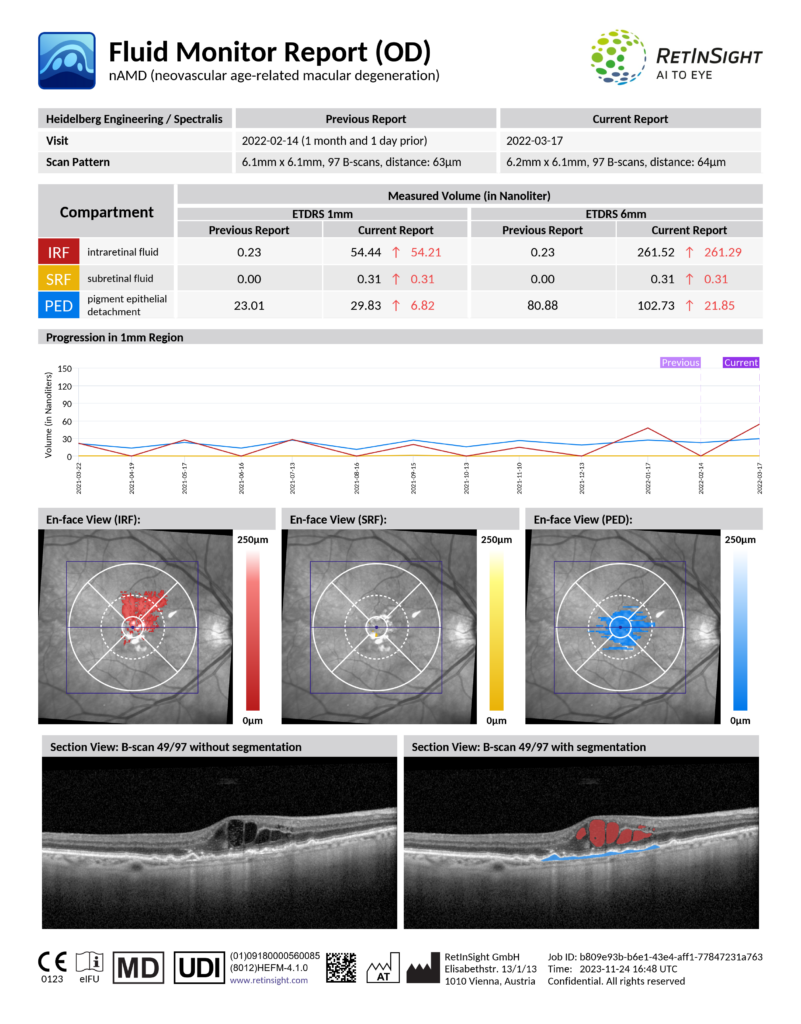
Sample of a RetInSight Fluid Monitor PDF Report
Key features of the RetInSight Fluid Monitor
- Precise visualization: Visualize the most important retinal fluid types and location automatically and at one glance
- Accurate fluid measurement: Accurately measure fluid-related biomarkers such as intraretinal fluid (IRF), subretinal fluid (SRF) and pigment epithelial detachment (PED) in nanoliters1 2 – with IRF being crucial for risk of aggressive disease and predicting significant vision loss over time3
- Dynamic follow-up charts: Generate follow-up charts of fluid dynamics for an individual overview of the recurrence profile
- Disease progression visualization: Visualize disease progression over time, enabling improved disease management
- Regulatory compliance: The RetInSight Fluid Monitor meets all MDR 2017/745 requirements for Class IIa medical devices, ensuring it adheres to the highest standards of quality and safety
Sample of a RetInSight Fluid Monitor PDF Report
Why the RetInSight Fluid Monitor is a game-changer in nAMD management
Looking for a more efficient way to detect pathological fluid in your patients’ OCTs?
- Objective evaluation: Move from subjective to objective evaluation with the ability to automatically quantify fluid in nAMD
- Follow-up function: Generate a follow-up chart of fluid dynamics to track individual recurrence profiles and visualize disease progression over time, facilitating disease management
- Efficient workflow: Integrate nAMD management seamlessly into your current optical coherence tomography (OCT) routine, streamlining workflow and enhancing efficiency
- Quality control: Replace time-consuming and error-prone manual retinal image analysis with fast, reproducible, and quantifiable data
- Patient communication: Foster patient compliance by delivering customized reports to patients increasing trust with self-explanatory, personalized reports
Visualization and quantification supporting robust diagnostic decisions in nAMD care
As a trusted leader in retinal care, RetInSight invites you to explore the Fluid Monitor and experience the next generation of nAMD management. Our innovative technology will empower you to make informed treatment decisions based on precise measurements and visualizations of fluid-related biomarkers.
The RetInSight Fluid Monitor meets all MDR 2017/745 requirements for Class IIa medical devices as Clinical Decision Support Systems (CDSS) for the monitoring of patients with nAMD, ensuring its adherence to the highest standards of quality and safety.
For more information and a demo of the RetInSight Fluid Monitor, please get in touch with our team. Together, let’s revolutionize the way we manage and treat wet AMD.
References
- Bianca Gerendas S. et al. | Validation of an automated fluid algorithm on real-world data of neovascular age-related macular degeneration over five years
- Gregor S. Reiter et al. | Performance of an Artificial Intelligence Decision Support Tool, the Vienna Fluid Monitor in Neovascular Age-Related Macular Degeneration. Presentation at Euretina 2022.
- Gregor S. Reiter et al. | Long-term effect of fluid volumes during the maintenance phase in neovascular age-related macular degeneration in the real world: results from Fight Retinal Blindness!
FAQs
What OCT biomarkers does the RetInSight Fluid Monitor automatically detect and quantify in clinical routine?
The Fluid Monitor provides automated detection, segmentation, and quantification of intraretinal fluid (IRF), subretinal fluid (SRF), and pigment epithelial detachment (PED) based on OCT image data, and in patients diagnosed with nAMD.
The output includes volumetric measurements and layer‑specific maps designed to support the assessment of retinal fluid in routine use.
How can automated fluid quantification support patient management?
The Fluid Monitor delivers quantified and visualized information on fluid structures visible in OCT scans.
This information can be used by eye care professionals as additional input when evaluating disease activity and when documenting changes over time as part of patient management.
How frequently should fluid be monitored to optimize patient management under anti VEGF therapy?
The Fluid Monitor can analyze fluid whenever an OCT scan is performed.
Monitoring frequency is determined by the clinic’s standard examination protocol and clinical judgment. The software provides consistent, quantitative outputs whenever OCT data is evaluated.
What are the advantages of using automated fluid analysis?
Automated analysis offers a reproducible quantification of fluid parameters, independent of operator variability.
This provides consistent measurements that can support the documentation and assessment of retinal fluid over time.
Is the Fluid Monitor supported by clinical evidence?
The Fluid Monitor is based on algorithms that have undergone technical verification and validation and clinical performance evaluation in accordance with applicable regulatory requirements under EU MDR, UK MDR, TGA, and Medsafe.
How can the Fluid Monitor support standardization across clinics or clinical teams?
By applying the same algorithmic criteria to each OCT scan, the Fluid Monitor provides reproducible quantitative outputs for all patients and across different users.
This can help align documentation practices within multi‑clinician or multi‑site environments.
How does the Fluid Monitor help clinics standardize assessments across multiple clinicians or locations?
By applying the same algorithmic criteria to every OCT scan, the Fluid Monitor provides consistent quantitative outputs across patients, clinicians, and sites.
This helps harmonize internal documentation and supports uniform interpretation of OCT derived fluid metrics within a clinic or network.
Does the Fluid Monitor integrate with existing OCT devices and clinical workflows?
The Fluid Monitor currently works exclusively with the Heidelberg Spectralis OCT. This is intentional.
Different OCT devices vary significantly in image quality, resolution, noise, and acquisition protocols. If you compare a Spectralis scan with one from another device, the difference is clear, and these differences directly influence how reliably an algorithm can detect and quantify biomarkers.
An algorithm optimized and validated on Spectralis images will not necessarily perform the same way on images from another OCT.
To avoid unreliable or inconsistent results, RetInSight does not use a “one‑algorithm‑fits‑all‑devices” approach. Each OCT platform requires its own dedicated integration and validation.
Support for additional devices is planned and will be released once validated for that specific hardware.
Why isn’t the Fluid Monitor device‑agnostic?
Because OCT devices are not created equal.
They differ in scan quality, resolution, noise characteristics, number of B‑scans, scanning speed, and acquisition consistency. These differences mean that AI algorithms trained on one device will not automatically deliver the same performance on another.
Rather than lowering performance to accommodate all devices, RetInSight validates the algorithm device‑by‑device to ensure consistent and reliable results.
This approach focuses on image quality and technical integrity, not generic compatibility.